

A corporate transportation policy is a formal set of rules that governs how employees book, use, and expense ground transportation during business travel. Without one, companies face unchecked spending, inconsistent vendor quality, and real gaps in Duty of Care. Companies with formal travel policies reduce total travel expenditures by 20–30% compared to those without written guidelines. That gap represents a direct, recoverable cost for any organization that travels at scale.
The industry term for this framework is a corporate ground transportation policy, though HR teams and finance departments often call it a business travel policy or employee travel policy. Both terms describe the same governance structure. The policy covers everything from approved vendors and vehicle types to expense submission deadlines and safety mandates. Getting it right in 2026 means addressing not just cost, but also compliance, traveler experience, and real-time enforcement.
What is corporate transportation policy and what does it include?
A corporate transportation policy governs ground transport in business travel by enforcing safety, efficiency, and cost controls across every employee trip. The policy defines who can travel, what modes are approved, how bookings are made, and how expenses are submitted. Think of it as the operating manual for every ground movement your company pays for.

Core components every policy must address
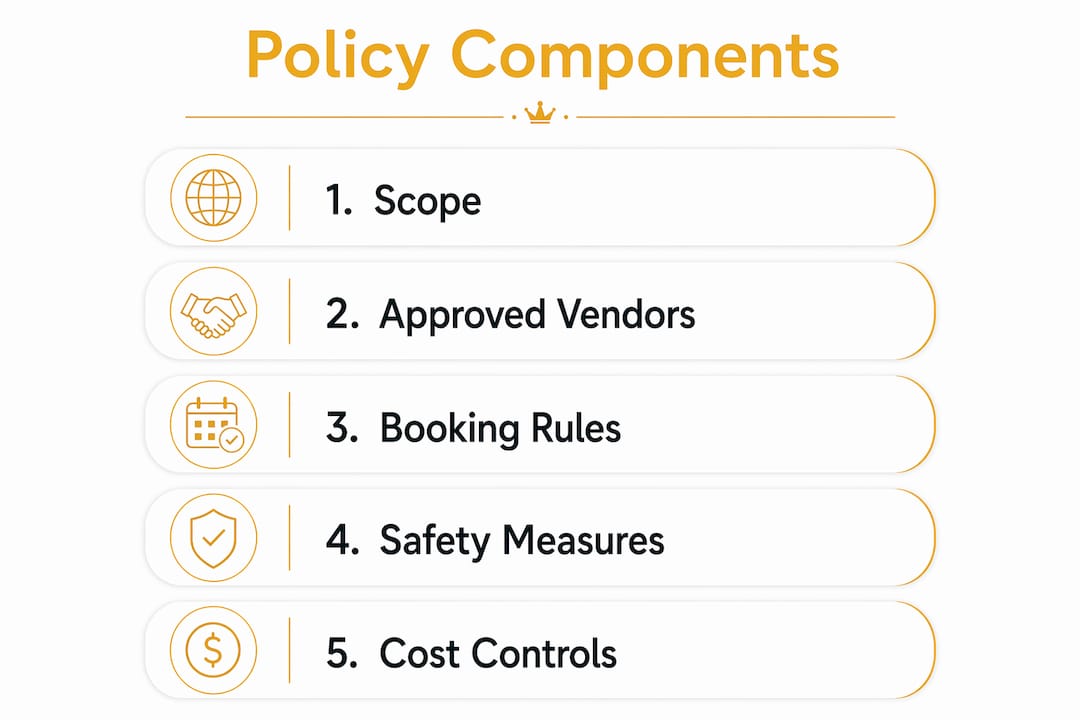
A well-built policy covers five distinct areas:
- Service level expectations: Vendor standards, vehicle requirements, and driver vetting. Mandating a single approved provider with $1 million in liability insurance and background-checked chauffeurs is the most direct way to enforce consistent Duty of Care.
- Booking and approval processes: Advance booking timelines, required platforms, and approval hierarchies. Airport transfers require 24-hour advance booking, while group transfers need 3–7 days’ notice to prevent budget overruns and logistical failures.
- Expense and reimbursement rules: Eligible transportation modes, cost caps per trip or per mile, and submission deadlines. Expense reports must be submitted within 14 days, with reimbursements processed within 5 business days after approval.
- Safety and compliance mandates: Duty of Care obligations, insurance minimums, and legal adherence by jurisdiction.
- Exception handling: Clear approval rules for out-of-policy requests, last-minute changes, and personal travel extensions.
Pro Tip: Draft your policy with a two-tier approval structure. Routine bookings go through the platform automatically. Exceptions above a set cost threshold require manager sign-off. This keeps the process fast for standard trips and controlled for outliers.
The table below shows how policy components map to business outcomes:
| Policy component | Primary business outcome |
|---|---|
| Approved vendor list | Consistent safety and service quality |
| Advance booking rules | Reduced last-minute cost premiums |
| Expense submission deadlines | Faster reimbursement and cleaner audits |
| Duty of Care mandates | Reduced legal and liability exposure |
| Exception approval process | Compliance without blocking urgent travel |
How can organizations cut costs through transportation policies?
Cost reduction is the most measurable benefit of a formal business travel policy. The 20–30% savings figure is not theoretical. It comes from eliminating ad-hoc bookings, enforcing preferred vendor rates, and removing the gray areas that employees fill with expensive choices.
Role-based vehicle assignment
Role-based vehicle assignment is one of the most underused cost tools in corporate transportation guidelines. Assigning luxury sedans to solo executive travelers and Sprinter vans to groups of four or more reduces the per-person cost substantially without cutting service quality. A group of six sharing a Sprinter pays far less per seat than six individuals each booking a private sedan.
- Define vehicle tiers by traveler role. Executives traveling alone qualify for a sedan or SUV. Teams of three or more default to a van or group vehicle.
- Set cost caps by vehicle tier. A per-trip cap for sedans and a separate cap for group vehicles prevents tier-jumping.
- Require all bookings through a centralized platform. Centralized booking platforms provide real-time visibility for emergency tracking and Duty of Care compliance. They also flag out-of-policy selections before the booking is confirmed.
- Audit monthly. Pull a report of all bookings, flag out-of-tier selections, and follow up with the booking employee and their manager.
- Review vendor contracts annually. Preferred vendor agreements lock in rates, but only if you renegotiate them before they expire.
Pro Tip: Add a “reason code” field to your booking platform for any out-of-policy request. Employees who must explain their choice in writing make fewer unnecessary exceptions.
The comparison below shows the cost difference between unmanaged and policy-managed transportation:
| Scenario | Unmanaged booking | Policy-managed booking |
|---|---|---|
| Solo executive, airport transfer | Variable, no cap | Fixed rate, approved vendor |
| Group of 6, airport transfer | 6 separate sedans | 1 Sprinter van, lower per-person cost |
| Last-minute booking | Premium surge pricing | Advance booking rule prevents surcharges |
| Expense submission | No deadline, delayed audits | 14-day rule, clean monthly close |
What best practices make transportation policies effective in 2026?
The biggest shift in corporate travel management over the past two years is enforcement timing. Modern policies enforce rules at the point of booking rather than relying on after-the-fact auditing. This change alone closes most of the compliance gap.
Best-practice corporate transportation guidelines in 2026 include the following standards:
- Flight arrival tracking: Best-practice policies mandate 30–60 minute flight tracking and meet-and-greet services for all airport transfers. This protects travelers from delays and removes the burden of tracking their own flight status.
- Centralized platform requirement: All bookings must go through a single approved system. Out-of-system bookings are the most common enforcement challenge, and they carry the highest risk of policy violation and reduced traveler safety.
- Approved vendor list: Every vendor on the list must carry minimum liability insurance and employ background-checked drivers. Spot-check vendor compliance at least twice per year.
- Personal travel extensions: The policy must state clearly whether employees can extend a business trip for personal travel and whether the company covers any transportation costs during the personal portion.
- Non-compliant booking consequences: Define the consequence for booking outside the policy. A written warning for the first offense and personal reimbursement responsibility for the second is a common and effective standard.
Clear rules and advance booking requirements reduce stress and budget overruns by removing employee ambiguity about what is and is not covered. Employees who know exactly what to book, how to book it, and when to submit expenses make fewer mistakes and fewer exceptions.
How to implement and maintain a corporate transportation policy
Building the policy document is the easy part. Getting employees to follow it consistently is the real work.
- Audit your current travel spend first. Pull 12 months of transportation expenses. Identify the top vendors, the most common routes, and the highest-cost outliers. This baseline shapes every decision that follows.
- Draft the policy with input from frequent travelers. HR writes the rules, but road warriors know the friction points. A policy built without their input will generate exceptions from day one.
- Select a centralized booking platform. Tools like Concur, TravelPerk, or Navan enforce policy rules automatically at the booking stage. They also generate the audit data you need to monitor compliance over time.
- Train every employee who travels. A one-page policy summary and a 20-minute onboarding session are enough for most employees. The goal is clarity, not comprehensiveness.
- Set a review cycle. Review the policy every 12 months at minimum. Vendor contracts change, travel volumes shift, and new transportation modes emerge. A policy that is not updated becomes a policy that is not followed.
- Track compliance monthly. Measure the percentage of bookings made through the approved platform, the percentage of expense reports submitted on time, and the number of exception requests per quarter.
Pro Tip: Publish a one-page “quick reference” version of the policy alongside the full document. Employees who travel infrequently will not read a 20-page document. They will read a single page.
Aligning your corporate travel management approach with your broader HR and finance policies also matters. Transportation policy compliance improves when employees see it as part of a coherent system, not a standalone rule set imposed by procurement.
Key Takeaways
A corporate transportation policy reduces travel spend by 20–30%, enforces Duty of Care through approved vendors, and closes compliance gaps by requiring all bookings through a centralized platform before travel occurs.
| Point | Details |
|---|---|
| Define the policy scope clearly | Cover approved vendors, vehicle types, booking platforms, and expense deadlines in one document. |
| Enforce at booking, not after | Centralized platforms block out-of-policy selections before the trip is confirmed. |
| Use role-based vehicle assignment | Match vehicle type to group size to reduce per-person cost without cutting service quality. |
| Set firm submission deadlines | Require expense reports within 14 days and process reimbursements within 5 business days. |
| Review the policy annually | Update vendor lists, cost caps, and booking rules every 12 months to keep the policy current. |
The tension between control and traveler experience
The policies that fail are the ones built entirely around cost control. I have seen companies implement tight caps and rigid approval chains, then watch their top performers book personal credit cards and submit for reimbursement anyway. The policy technically existed. Nobody followed it.
The policies that work treat the traveler as a stakeholder, not a cost center. When an employee lands at 11 p.m. after a cross-country flight, the last thing they need is to hunt for a rideshare in a busy terminal. A meet-and-greet airport transfer with a named chauffeur holding a sign is not a luxury indulgence. It is a Duty of Care decision that also happens to cost less than an expensed black car booked at the curb.
The exception handling piece is where most policies break down. A policy that has no clear path for last-minute changes forces employees to make unauthorized decisions. Build a fast-track exception approval process. One manager, one email, 30 minutes. If the exception process is slower than just booking outside the policy, employees will always choose speed.
The companies that get this right use a single vetted provider with consistent service standards. They do not negotiate the cheapest possible rate. They negotiate the most predictable rate with the most reliable service. Predictability is what keeps travelers compliant and finance teams happy at the same time.
— Dee
Why Pdalimo fits your corporate transportation policy
Companies building or updating their corporate transportation guidelines need a ground partner that already operates to policy-grade standards.
Pdalimo provides corporate transportation in Orlando with flight monitoring, pre-planned routes, and 24/7 support built into every booking. Chauffeurs are background-checked, vehicles are fully insured, and meet-and-greet service is standard for airport transfers. That means your policy’s Duty of Care requirements are met from day one. Whether you are moving a solo executive or a group of 12 to a conference, Pdalimo matches the vehicle to the group size to keep per-person costs in line with your corporate travel policy budget. Contact Pdalimo to discuss a service agreement aligned with your company’s transportation policy.
FAQ
What is a corporate transportation policy?
A corporate transportation policy is a formal document that defines how employees book, use, and expense ground transportation during business travel. It covers approved vendors, vehicle types, booking platforms, cost caps, and Duty of Care requirements.
How much can a transportation policy reduce travel costs?
Companies with formal corporate transportation guidelines reduce total travel expenditures by 20–30% compared to companies without written policies. The savings come from preferred vendor rates, advance booking rules, and elimination of unauthorized bookings.
What is Duty of Care in a corporate travel policy?
Duty of Care is a company’s legal and ethical obligation to protect employees during business travel. In ground transportation, it means using approved vendors with minimum liability insurance and background-checked drivers.
How far in advance should airport transfers be booked?
Best-practice policies require airport transfers to be booked at least 24 hours in advance. Group transfers involving four or more travelers require 3–7 days’ notice to secure the right vehicle and avoid last-minute cost premiums.
What happens when an employee books outside the policy?
Out-of-system bookings are the most common compliance failure in corporate transportation. Most policies require a written explanation for the first offense and hold the employee personally responsible for reimbursement on repeat violations.


