

Corporate event transportation is the coordinated system of managing attendee movement before, during, and after events to deliver timing precision and minimal disruption. Most planners treat it as a vehicle booking task. It is not. Understanding how corporate event transport works means recognizing it as integrated logistics, where arrival priorities, routing decisions, and real-time adjustments all function as one connected system. Get that system wrong, and the entire event schedule unravels before the first session begins.
How corporate event transport works: timing comes first
The single biggest mistake planners make is choosing vehicles before they define arrival priorities. Timing is the foundation of every transport decision that follows. When you know which attendee groups must arrive together, which can stagger, and which require VIP protocols, vehicle assignment and routing become straightforward.
Transport planning fails when it is treated as simple vehicle booking rather than an integrated scheduling function. That failure shows up as missed arrivals, cascading session delays, and frustrated executives standing outside a venue with no car in sight.
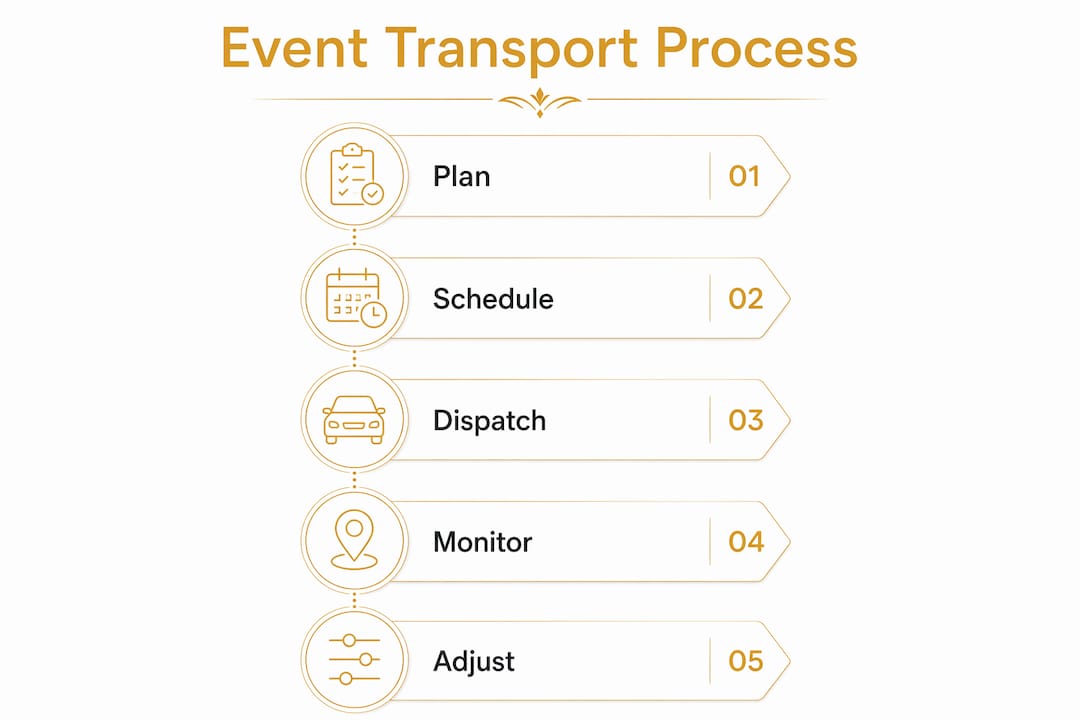
The planning sequence that works looks like this:
- Define arrival windows for each attendee group, VIPs first
- Map pickup locations against venue access points and any restrictions
- Assign vehicle types based on group size and timing, not preference
- Build buffer time into every transfer leg to absorb unpredictability
- Designate a single lead dispatcher who owns the entire transport program
Pro Tip: Submit your complete transfer schedule 5–10 business days before the event and assign a named lead dispatcher at that same time. Waiting until the week of the event guarantees avoidable conflicts.
Staggered arrivals also reduce bottlenecks at venue entry points. A 400-person conference where every attendee arrives in a 20-minute window creates a traffic and check-in crisis. Spreading arrivals across 90 minutes with coordinated shuttle loops solves that problem before it starts.
What are the best vehicle options for corporate events?
Vehicle selection is where planners often over-invest in prestige and under-invest in practicality. The right vehicle is the one that matches your group size, schedule, and venue access, not the most impressive option in the catalog.

VIP transport requires dedicated protocols to protect brand perception. A C-suite executive arriving in a shared shuttle when a luxury SUV was promised is a brand failure, not just a logistics error.
| Vehicle Type | Capacity | Best Use Case | Relative Cost |
|---|---|---|---|
| Luxury SUV | 4–6 passengers | VIP and executive transfers | High |
| Stretch limousine | 8–10 passengers | VIP arrivals, brand moments | High |
| Executive van | 10–14 passengers | Small group transfers | Moderate |
| Coach or shuttle bus | 30–55 passengers | Large group movement between venues | Low per head |
| Rideshare (app-based) | 1–4 passengers | Overflow or informal attendees | Variable |
Shuttle programs at large conventions add measurable convenience and reduce parking pressure at venues. For events with 200 or more attendees, a dedicated shuttle fleet is almost always more reliable and cost-effective than coordinating individual rides.
Professional conference car services track flights in real time and adjust chauffeur schedules automatically for delays or early arrivals. Rideshare apps do not do this. For airport logistics, that difference between a professional service and an app-based option is the difference between a smooth arrival and a 45-minute wait at baggage claim.
Pro Tip: Select your vehicle mix based on the event schedule, not convenience. If your program has a hard start time, every vehicle assignment must account for worst-case traffic, not average traffic.
For planners organizing executive-level events in Orlando, the corporate transportation guide for the Orlando Convention Center offers venue-specific routing and fleet recommendations worth reviewing before you finalize your plan.
How do you manage transport logistics on event day?
Day-of transport management is where even well-planned programs break down. Traffic, weather, flight delays, and last-minute attendee changes are not exceptions. They are standard variables you must plan to absorb.
The most effective approach prioritizes flexible, real-time communication and pre-positioned staff over rigid pre-planned schedules. A schedule is a starting point, not a contract with reality.
Here is the contingency framework that experienced transport coordinators use:
- Establish a centralized command center with one dispatcher who has authority to reroute vehicles without waiting for approval chains.
- Pre-position vehicles at key pickup points 20 minutes before the first scheduled transfer, not at departure time.
- Monitor all inbound flights in real time and update chauffeur assignments the moment a delay or early arrival is confirmed.
- Run shuttle loops continuously rather than on fixed departure times. Continuous shuttle loops reduce bottlenecks and improve attendee satisfaction more than any other single operational change.
- Maintain a reserve vehicle at or near the venue for overflow, breakdowns, or unplanned VIP requests.
- Communicate proactively with attendees via text or app updates when transfers are running behind schedule.
Centralized logistics command centers reduce incidents and enable faster decisions during live events. The difference between a dispatcher managing 10 vehicles from a single screen versus 10 drivers managing themselves is the difference between control and chaos.
Pro Tip: Assign one staff member exclusively to VIP transport tracking on event day. That person’s only job is to know where every executive vehicle is at every moment.
For corporate group retreat transport, the same principles apply with one addition: remote venues often have limited cell coverage, so pre-loaded offline maps and printed route sheets for every driver are non-negotiable backup tools.
What are the biggest operational risks in event transport?
Nearly 71% of event managers identified transportation delays, guest misrouting, or vehicle unavailability as their top operational risk for corporate events. That number reflects how often transport is under-resourced relative to its impact on the overall event experience.
The risks cluster into three categories: planning failures, execution failures, and vendor failures. Each requires a different mitigation strategy.
- Demand forecasting gaps cause fleet shortages and cost overruns. Accurate demand forecasting eliminates guesswork and prevents last-minute scrambles for additional vehicles.
- No VIP protocol documentation leaves chauffeurs without clear instructions, creating inconsistent service for your most important attendees.
- Single-vendor dependency means one breakdown or no-show collapses your entire transport program. Always have a backup vendor confirmed in writing.
- No post-event analytics means you repeat the same mistakes at the next event. Tracking on-time performance, vehicle utilization, and attendee feedback creates a baseline for continuous improvement.
- Late transport planning is the root cause of most failures. Planners who finalize transport within two weeks of the event consistently face higher costs and lower service quality.
- Rigid schedules with no buffer turn minor delays into cascading failures across the full event timeline.
- Poor attendee communication leaves guests stranded or confused about pickup locations, creating a negative first impression that colors the entire event experience.
For practical guidance on building a transport risk checklist, the corporate event transportation tips resource from Fort Lauderdale VIP Car Service covers vendor vetting and contingency documentation in useful detail.
Key takeaways
Effective corporate event transport requires integrating timing priorities, vehicle selection, and real-time coordination into a single managed system, not treating each as a separate task.
| Point | Details |
|---|---|
| Timing drives every decision | Define arrival priorities and windows before selecting vehicles or routes. |
| Match vehicles to the schedule | Choose vehicle types based on group size and timing requirements, not prestige. |
| Run continuous shuttle loops | Dynamic loops outperform fixed departure schedules for large group movement. |
| Centralize day-of command | One dispatcher with full authority reduces incidents and speeds up decisions. |
| Plan for risk, not best case | Demand forecasting, backup vendors, and VIP protocols prevent the most common failures. |
Transport logistics taught me to plan for the worst first
Most event planners I speak with build their transport plan around the best-case scenario. Flights land on time, traffic flows, and every attendee knows exactly where to go. That plan works about 60% of the time. The other 40% is where reputations get made or damaged.
The planners who consistently run flawless events do one thing differently. They design their transport program around failure modes first. They ask: what happens if the lead vehicle breaks down? What happens if a keynote speaker’s flight lands 90 minutes late? What happens if the venue blocks the shuttle entrance? They answer those questions in writing before the event, not in the moment.
Technology helps, but it is not the answer on its own. Live tracking apps and centralized dispatch platforms give you visibility. They do not give you judgment. That judgment comes from experienced local operators who know the roads, the venues, and the variables specific to your city. In a market like Orlando, where convention traffic, theme park crowds, and airport volume all interact, local knowledge is a genuine operational advantage.
My strongest recommendation is this: treat transport as the first item on your event planning checklist, not the last. Secure your transport vendor at the same time you book your venue. Brief your dispatcher with the same depth you brief your AV team. And never assume that a vendor who handles leisure travel automatically understands the precision that corporate event transport demands.
— Dee
Plan your next corporate event transport with Pdalimo
Corporate event transport in Orlando requires a provider who understands the specific demands of conference schedules, executive arrivals, and large group coordination. Pdalimo specializes in exactly that.
Pdalimo’s fleet includes luxury SUVs, executive vans, and shuttle options sized for groups of any scale. Every transfer is managed through centralized dispatch with real-time flight monitoring, so your attendees arrive on schedule regardless of what happens at the airport. Whether you are coordinating a 20-person executive retreat or a 500-person conference, Pdalimo brings the same level of precision to every transfer. Explore Orlando corporate transportation options and secure your fleet before your preferred dates are taken.
FAQ
How far in advance should i book corporate event transport?
Book your transport vendor at the same time you confirm your venue, typically 60–90 days out for large events. Submit your complete transfer schedule 5–10 business days before the event to allow time for route planning and vehicle assignment.
What is the difference between a shuttle service and a private car service for corporate events?
Shuttle services move large groups between fixed points on a continuous loop and work best for general attendee movement. Private car services provide dedicated vehicles for VIP and executive transfers, with real-time flight tracking and personalized chauffeur service.
Why do corporate events need a lead dispatcher?
A lead dispatcher provides a single point of authority for all transport decisions on event day. Centralized command reduces response time during delays and prevents conflicting instructions from reaching drivers.
How does real-time flight tracking improve corporate transport?
Professional services monitor inbound flights and automatically adjust chauffeur schedules when delays or early arrivals occur. This eliminates the most common cause of missed airport pickups at corporate conferences.
What is the top operational risk in corporate event transport?
Transportation delays, guest misrouting, and vehicle unavailability are cited as the top operational risk by 71% of event managers. Structured demand forecasting and backup vendor agreements are the most direct mitigations.


